

Mindfully preparing a cup of tea and a traditional Japanese tea ceremony are not the same. Those who know the differences can respectfully discover Japanese tea culture while also developing a simple tea ritual for their own everyday life.
Ritual & Space | SteinKunstWerk | October 13, 2026

Start at home with a familiar process
First, choose whether you want to steep loose-leaf tea or prepare matcha. The appropriate accessories depend on this step, not on having a complete set. A personal tea break can be simple; for the formal process of a school, their own courses and instructions are the right way to delve deeper.
What is a Japanese tea ceremony?
Japanese tea culture uses the terms Chadō or Sadō ("the way of tea") and Chanoyu. The tradition encompasses far more than a beverage: the host and guest dedicate themselves to a unique encounter, the preparation of the space, the careful handling of objects, and the shared drinking of matcha. The Urasenke school describes mutual attentiveness and hospitality as central elements.
A formal process is learned and practiced. We expressly provide no instructions for an authentic ceremony here, but rather an introduction and tips for a personal tea break.
Sencha, matcha, and herbal tea: not everything is the same
| Tea | Preparation | Note |
|---|---|---|
| Sencha | Green tea leaves are steeped in water and then strained or filtered. | Choose the water temperature and steeping time according to the package instructions. |
| Matcha | Finely ground green tea is mixed with water or whisked. | The tea powder is drunk with the beverage; dose the amount mindfully. |
| Herbal or fruit tea | Depending on the blend, pour boiling water over it and let it steep. | Different base material; observe hygiene and preparation instructions. |
Sencha and matcha contain caffeine. Those who are sensitive or have difficulty falling asleep in the evening should consider the amount and time. Find out more in the caffeine guide.
What do you need for matcha at home?
For a simple matcha, suitable matcha powder, drinking water, a clean vessel, and a suitable stirring tool are sufficient. Traditional utensils such as a chawan (tea bowl), chasen (bamboo whisk), and chashaku (bamboo scoop) have their own functions and cultural context. Those who are new to it should first understand the taste, dosage, and handling before deciding which accessories make sense.
A mindful tea break in six steps
- Choose a space: A tidy surface and a stable place to sit are enough.
- Prepare the water and dishes: Use clean vessels and the recommended water temperature.
- Dose the tea: Follow the variety and the manufacturer's instructions.
- Prepare it mindfully: Observe the color, aroma, and preparation time without trying to replicate a traditional ceremony process.
- Taste mindfully: Drink in small sips. With matcha, the taste is often stronger than with a loose-leaf infusion.
- Finish together or alone: Put away the dishes and remember which preparation you enjoyed.
This is an everyday enjoyment routine, not a Japanese tea ceremony. It requires neither special worldviews nor a specific room design.
Tea and room fragrance: less is often better
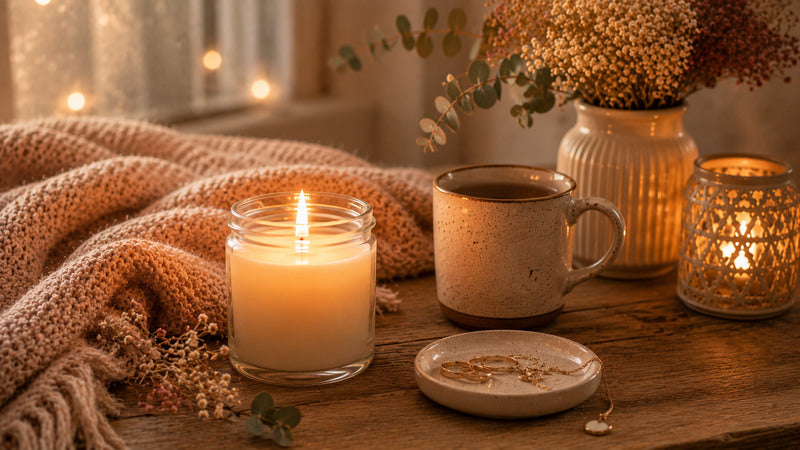
Delicate tea aromas can be perceived more easily if there are not several intense fragrance sources running simultaneously. A quiet tabletop and pleasant lighting support the atmosphere. Supervise burning candles and keep them away from paper, curtains, and other flammable materials.
Where can you learn about Japanese tea culture in North Rhine-Westphalia?
A concrete starting point is the Green Tea Culture Seminar at the EKŌ-Haus Düsseldorf on November 20, 2026. It covers sencha and matcha and includes a mini demonstration and tasting; the organizer expressly states that it is not a tea ceremony. In addition, the EKŌ-Haus hosts traditional tea ceremonies as its own events, including dates on November 21 and December 12. As of October 13, the ceremony on November 21 is already sold out; registration for December 12 begins on November 12. Please check availability and registration with the EKŌ-Haus.
Current dates are available in the Event Calendar for Tea and Rituals in North Rhine-Westphalia.
Discover tea culture at SteinKunstWerk
Those who want to prepare tea at home or give a mug as a gift will find suitable options in our sections OCHA & Matcha, Tea Varieties, Tea Accessories, and Tea Culture & Ceramics. Shop products are not components or official teaching materials of an Urasenke ceremony.
Frequently Asked Questions
Is drinking matcha automatically a tea ceremony?
No. Matcha can be drunk quite casually. The traditional tea ceremony involves a learned cultural process with a host and guests.
Do I have to sit on the floor?
No. The tea ceremony has various forms; for a personal tea break at home, a suitable place is enough. The Urasenke school also describes an introductory form at a table and chairs.
Can tea help with sleep disorders?
Tea is not a treatment for sleep disorders. Green tea and matcha contain caffeine in particular; for sleep problems, a caffeine-free alternative may be useful.
Kommentare
Kurze Gedanken zählen. Wenn du magst: setz den ersten Ton – oder antworte direkt mit @Name:
Pro-Tipp: Wenn du jemandem antworten willst, starte mit @Name:
Mach aus dem Lesen ein Ritual.
Wenn dich der Beitrag gerade trifft: nimm die Stimmung mit – als Duft, Deko oder Geschenkidee.
Mach aus dem Lesen ein Ritual.
Wenn dich der Beitrag gerade trifft: nimm die Stimmung mit – als Duft, Deko oder Geschenkidee.
Passt der Beitrag zu dir?
Zur Kollektion